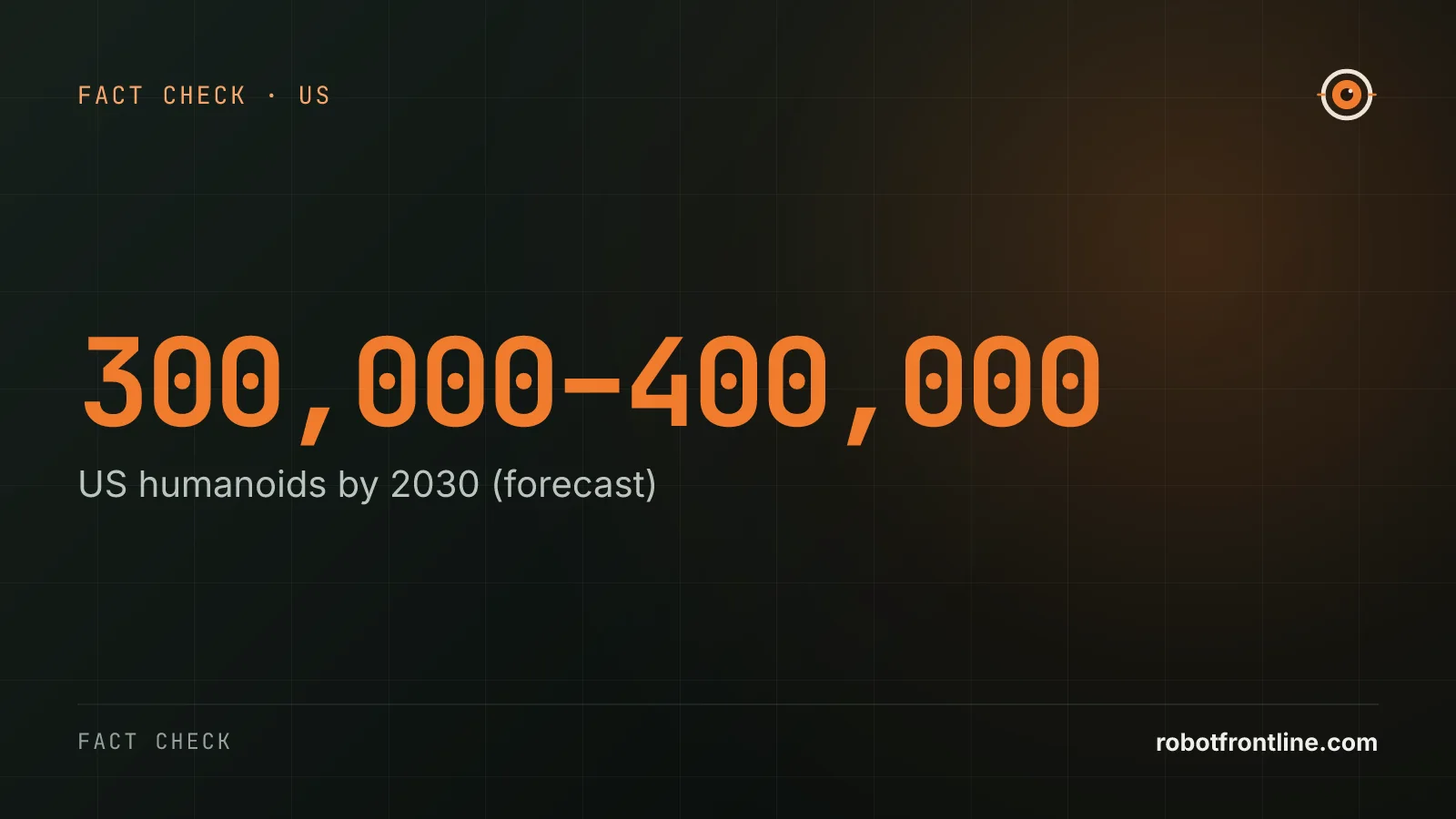
On November 12, Reuters reported a J.P. Morgan forecast: US humanoid robot production could reach 300,000 to 400,000 units by 2030, and about 1.5 million by 2035. It’s the kind of number that ends up in headlines and pitch decks. Here is what it actually says, and what it leaves open.
What the forecast says
According to the reports, the bank expects humanoids to arrive first in manufacturing, logistics and warehousing, driven by labor shortages, better economics and rising production capacity. Its key point is that near-term growth is “supply constrained”: the limit isn’t customers, it’s the ability to build robots.
The bottlenecks it names are hands, actuators (the motors in the joints), the AI “brain,” and factory capacity, with training data and computing power also holding deployment back. It expects the market for actuators, motors and vision systems to approach $30 billion by 2035.
On costs, the bank says humanoids are nearing parity with human labor, and that a customer running robots across several shifts could save about $100,000 a year. The reports don’t include the per-robot price or the wage assumptions behind that figure.
What it doesn’t say
Annual or cumulative? This is the biggest gap. The reports don’t say whether 300,000 to 400,000 means robots built in 2030, or the total built by 2030. The difference is enormous, and the underlying note hasn’t been published.
It’s a projection, not a count. No one is building humanoids in the US at anything close to this scale today. The forecast describes a possible future, under the bank’s assumptions.
Putting the number in context
Three reference points help.
Today’s global shipments. Market tracker IDC estimated that about 25,000 humanoids shipped worldwide in the first half of 2026, with Chinese makers accounting for more than 95 percent. Even doubled for a full year, that’s a small fraction of 300,000, and most of it isn’t made in the US.
Makers’ own targets. According to the reports, most US humanoid makers other than Tesla are aiming for 10,000 to 30,000 robots a year. If 300,000 to 400,000 is an annual figure, the US would need the equivalent of 10 to 40 companies hitting the top of those targets at the same time, or one very large producer. Tesla started Optimus production in Fremont in October and expects deliveries to outside customers toward the end of 2027.
Real orders. Some of the biggest commitments so far are conditional. This week GXO signed a non-binding letter of intent with Apptronik for up to 1,000 Apollo humanoids over four years, depending on trials. Agility’s order for 1,000 Digit robots releases units in stages as use cases are proven. These are meaningful deals, but they’re in the thousands, not the hundreds of thousands.
Why “supply constrained” matters
The bank’s framing is useful because it shifts the question from “will anyone want humanoids?” to “can anyone build them?” On that, the evidence is mixed:
- Costs are falling. Agility says the bill of materials for its Digit 5 drops from about $150,000 at launch to a target of $30,000 at 10,000 units a year. That’s a target, not a current figure.
- Parts are political. On October 28 the White House said imports of robots and their parts threaten US national security. It imposed no tariffs for now and ordered trade talks, with an update due within 180 days. Separately, the rare-earth magnets in humanoid motors are mostly refined in China, and one industry estimate says avoiding Chinese magnets could push a US humanoid’s build cost from about $46,000 to $131,000.
In other words, the same supply chain the forecast depends on is the one under the most pressure.
The bottom line
The J.P. Morgan figure is a forecast from a bank, reported second-hand, from a note that isn’t public, and it doesn’t say whether it counts robots per year or in total. What it does usefully say is that the constraint on humanoids is now manufacturing: hands, motors, AI and factories.
Until the note is published, treat “400,000 by 2030” as a ceiling scenario, not a prediction you can plan around.
Robot Frontline doesn’t give investment advice. The bank’s report also names component suppliers it favors; we don’t list them here.